Ok, I ran into this a few times when running the Android signed package export utility and FINALLY found an article to help…

Make sure you aren’t using a comma in your certificate.

For example, my company name is The Auri Group, LLC. Taking the comma out of the organization name appears to have fixed my issue.

I hope this helps everyone out there 🙂

Best,

-Auri

I was pulling my hair out trying to resolve this issue. I uninstalled WCF from the .NET Framework 3 and tried to install .NET Framework 4’s WCF using ServiceModelReg.exe.

We all know this fun error: [Warning]A previous version of Windows Communication Foundation was detected.

And this one, too: [Warning]The HTTP namespace reservation already exists.

So, there are a lot of tutorials for how to fix this in IIS7 using netsh http. But what about those of us not running Windows Server 2008? Those of us running Windows Server 2003 need some love, too!

So, here’s what I did to solve it.

1. I uninstalled WCF from v3.x\Windows Communication Foundation\ServiceModelReg.exe –ua

2. I installed the httpcfg utility (which you can download from me here, since it’s not easily found anywhere on Microsoft’s site) to remove the namespace reservation that for some reason doesn’t get deleted after uninstalling WCF

3. Open up the command line and type the following:

httpcfg.exe query urlacl

You’ll probably see something like the following:

image

What’s causing all the problems is that last item. Why this isn’t easier to delete in Server 2003 I have no idea, but who cares… here’s what you do:

4. Delete the *.80 reservation by typing the following command:

httpcfg.exe delete urlacl -u ANNOYINGURL

…where ANNOYINGURL is the entry after URL : in the screen shot above. So, in my case it would be:

httpcfg.exe delete urlacl -u http://+:80/Temporary_Listen_Addresses/

5. Now, you should see something similar to the following after running this command:

HttpDeleteServiceConfiguration completed with 0.

That means the reservation has been deleted. Excellent!

6. Query the metabase again and you’ll see the reservation is gone. Your screen will look something like the following:

image

7. Restart IIS for good measure. If you don’t know how to do this, simply type the following command:

iisreset

The results of running this command will look similar to the following:

image

8. Now try reinstalling WCF and you should be good to go!

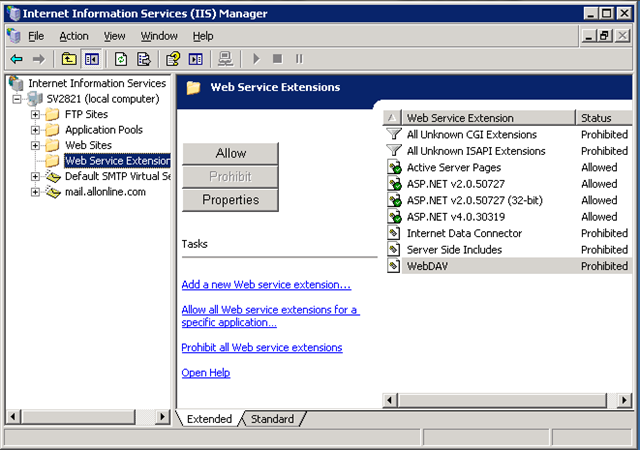
Update (10-Jun-2010): Is your Web service or Web site not working after installing .NET Framework 4.0 on Windows Server 2003 + IIS6? Make sure you ENABLE the framework, as shown in the figure below:

image

Good luck!

Best,

-Auri

Additional Information From a Reader:

I was passed this information from Andreas Warberg… you may also find it helpful 🙂

Hi Auri

I hoped to be able to comment directly on the article or send you a private message but it seems this has been disabled 😉

So below is my feedback:

I found your article and it helped me to upgrade from WCF 3.0 to 4.0 on IIS6. Thank you very much!

I noticed the link to httpcfg.exe was broken so I wanted to send you this link to Windows Server 2003 support tools http://www.microsoft.com/downloads/details.aspx?FamilyID=96a35011-fd83-419d-939b-9a772ea2df90&displaylang=en from where you can download and install support.cab and suptools.msi.

Installing this will give you a copy of httpcfg.exe and I suggest you add it to your otherwise great article.

I am using WCF (.svc) and a thing I experienced was that no application extension was automatically registered for svc-files. I had to do this manually by going to Default Web Site (insert correct Web Site Name here) Properties > Home Directory > Configuration. Here I added a new Application Extension Mapping for Extension = svc and Executable = c:\windows\microsoft.net\framework\v4.0.30319\aspnet_isapi.dll.

Maybe this could make it into the article for the benefit of us who are still using Windows Server 2003… 🙂

Best regards,

Andreas Warberg

TIP: If you’re running IIS7 on Vista or Windows Server 2008, the process is MUCH easier. Simply open a command line and enter the following:

netsh http delete urlacl "http://+:80/Temporary_Listen_Addresses/"

Done!


UPDATE: Another great option is to use GenyMotion and configure it to use Fiddler as a proxy.

Ok, I wrestled with this for days, but finally have it figured out. If you’re trying to make the Fiddler HTTP Proxy work with the Android emulator so you can debug web services and the like, here’s how to do it:

Configuring Fiddler

First we need to configure Fiddler to accept traffic from the emulator. In this case I am running Fiddler on the machine that is also hosting the emulator.

1. Start Fiddler

2. Go to Tools, then Fiddler Options

image
Figure: Going to Tools –> Fidler Options

3. Configure General and Connections tabs to look like the ones below:

image
Figure: The General tab’s settings

image
Figure: The Connections tab’s settings

4. Click OK

5. Quit and Relaunch Fiddler (important!)

6. Enable the Streaming feature in Fiddler so HTTP requests are shown as they occur.

image
Figure: The streaming option in Fiddler (shown in disabled state)

Configuring the Emulator

1. Start the emulator

2. Go to Settings, then Wireless controls

image
Figure: Wireless controls option

It is normal for tapping Wireless controls to cause a crash. Just try again and it will work. Don’t ask me why the emulator is so buggy – complain to Google.

3. Tap Mobile networks

image
Figure: Mobile networks option

4. Select Access point names

image
Figure: Access point names option

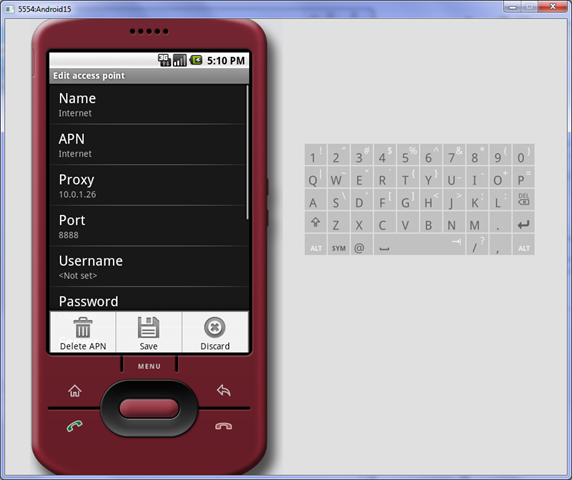
5. Choose the selected access point and configure the following options:

– Name : Internet
– APN : Internet
– Proxy : Fiddler’s proxy IP address (10.0.1.26 in my case)
– Port : Fiddler’s proxy IP port (8888)
– Username : <Not set> (clear it if anything is already there)
– Password : <Not set> (clear it if anything is already there)
– MCC : 310
– MNC : 260

Don’t play with any of the other settings!

image

Note: This part is special thanks to Xeros who posted to this thread.

6. Press MENU and then press Save

image

7. Keep going back until you’re at the home screen. I don’t know if this makes a difference, but I’m just making sure…

8. Try loading a Web site and you should see the traffic in Fiddler.

image
Figure: Web traffic still works, but is flowing through Fiddler.

image
Figure: Traffic being captured in Fiddler.

That should do it!

Note: You may need to disable Windows Firewall to make this work. Obviously I don’t need to tell you not to do this on a public network.

If you have any questions, please let me know on our support site.

You’ll be able to have beta versions and other versions to get your app in front of press, analysts, and so forth to get press and feedback. That’s cool.

Question: Can people follow us as a company / pin us to the marketplace, since they like our brand?

“Informed Purchase Decisions”

  • Try and buy
  • Detailed product description
  • Screen shots
  • Reviews & ratings
  • Related apps
  • Option game content rating
  • More apps by developer

Question: How are ratings sorted?

Question: There’s a related option, and this shows off the most popular items in other categories and so forth. This would bother me as a developer, since it’s putting my competitors in my description. What if I’m not a #1 app? Do the #1 apps appear? And how do I make sure I’m part of my competitor’s listings as well?

Answer (?): This is for the benefit of the customer.

Question: Why aren’t app updates automatically installed?

Question: Is application data retained across updates?

Answer; The question appears to be Yes, but we’re going to talk more about it offline.

You’ll be able to see change notes in app updates.

Drive Consumer Connection

  • Every app appears in App list
  • Pin favorite apps to Start
    • “Add to quick launch”
  • Live tiles offer a unique way to connect with customers
    • Can act as a banner with info about your company and so forth (so does that mean it can shimmer ads?)
  • Provide dynamic information about your app, game, business or other products

Announcement: App submission guidelines will be available online in MAY at http://developer.windowsmobile.com.

Average certification time is 5 days.

How You Profit

  • Single software distribution channel
    • Worldwide access, easy of discovery, convenient updates & distribution
  • Active merchandising
    • Team looks for “very very best” applications and games and find interesting ways to showcase those to people
  • 70% Revenue Share
  • Trial API
    • No details provided other than saying we’ll make more money if we provide Trial versions.
  • Credit card & mobile operator billing
  • Paid, freemium (try then pay for full version), ad funded and free apps
  • Question: Will there be Bing advertising inside apps?
  • More information on all this coming in May.
  • Showing a map of where you can get paid. Oddly enough, all of Africa appears to be out of the question. Interesting.

Existing accounts will just work – so if you’re already a developer, you won’t have to do anything to keep your account active.

Students in DreamSpark will now be able to submit apps.

They recommend provided a very nice background image for your app – “make it pop.”

You’ll be able to control your publish date (yahoo!).

Question: When do we get access to Trial API?

This is the code for determining trial mode: if (CurrentLicense.IsTrial().Equals(true)

Test Criteria Principles

  • Phone functionality is protected
  • Applications are well-behaved on the phone
  • The certification process is “Super predictable and timely” for developers
  • 98% of content is making it through the process in 5 days or less

Test Criteria Pillars

Technical validation

  • Apps are reliable
  • Use resource efficiently
  • Apps are free of malicious software
  • Apps do not inerfere with the phone functionality

Policy Validation

  • Meets Microsoft’s standards for global content policies
    • Content must match what MS is allowing

Market Validation

  • Making sure they’re compliant with local laws

Tools and Resources

  • Geographic sales and fulfillment reports
    • See how your apps are performing globally
  • Integrated licensing for trial applications
    • Question: Do we have access to email customers? Error reporting?
  • Device registration service
    • Unlocks retail devices for development
    • Manage registered devices through the developer portal
    • Your device gets unlocked “for a period of time”

Question: When will be be able to start publishing Windows Phone 7 apps?

Answer: Later this summer.

Q&A

Right now there is no discount capability. But you are able to change your pricing at any time (basically, you can run sales)

Not a lot of info about Beta Scenarios, but they are looking at offering a beta invitation program so you can invite people to help beta test / review / etc. the app.

Opening up the Marketplace API is planned for the long term, but not at launch.

To submit a paid update, you need to submit a separate app to the marketplace. You can also expire the old version.

Enterprises will have to go through the same developer registration process. This also applies to those who already create Xbox premium games – and will likely require you to work with the Xbox games.

Carrier pre-loaded software will be supported.

Subscription models are not supposed yet, but more info will be coming in May.

Pre-publication test tools (Hopper, App Verifier), and in-game purchases: 1) Definitely a goal to release pre-certification tooling. 2) Not yet supported. More info in late May.

How many apps are targeted at launch? No number has been published publically.

You can take people to the product purchase case from your app.

Current developer license includes 5 submissions for $99 but that policy will be updated in May.

Users will multiple devices, or purchaser of a device and gets a new one. Since the users’ phone is chained to their live ID, so they will be able to get their apps back. There is a limit of 5 Windows Phone devices, so supposedly a registered PC (say, one that’s running Zune), your XBox, and Zune HD, do not count.

There will be no parental controls at launch. However, content levels are supported. This will be a “PG-13” level market, and there will not be any Mature Level titles in there.

Buy Once Play Anywhere on XBox, Windows Phone – not at  launch.

Payment threshold is combined – you don’t have to pass the $200 in Ireland, France, so forth – as long as you sell $200 across all apps, you get paid.

Contact Information

Follow them on @wp7dev

Presenters: Todd Biggs: toddb@microsoft.com, John Bruno: jobruno@microsoft.com

  • “Modern OS” – virtual memory support with paging, networking, similar to Windows.
  • Integration with Bing search and maps.
  • DirectX-capable hardware
  • Application rutime uses CLR, with other capabilities: Silverlight UI, XNA for gaming, 3D and 3D graphics and content pipeline, and HTML + Javascript. Animation, Gaming, and HTML are the three key areas.
  • XAP package used to deploy app to phone using deployment to Marketplace. Microsoft checks the code, sign the code, and issue a license.
  • Application license is a crypto-verifiable object issued to grant rights to an application
  • (this model also guarantees Microsoft, just like Apple, always gets their cut of app profits – editor)
  • Phone handles all aspects of XAP installation based on the manifest. Individual apps will not be able to make arbitrary changes to the phone during installation.
  • Individual apps do not control their own lifecycle on the phone.
  • The Marketplace also controls revocation.
  • Both Trial and Beta are supported via Marketplace as well.
  • Apps are sandboxes into separate security accounts created while installed and at runtime.
  • Resource allocation policy keeps the foreground app responsive.
  • Resource management policy ensures the user can always use Start to run a new app.
  • Phone only runs apps that have a valid marketplace license.
  • Each app executes inside an isolated least privileged host process.
  • All app code is transparent and CLS-verifiable (making sure its not tampered with), mitigating impact of common attacks.
  • Frameworks enable app code to interact with app model, UI model, and phone functionality.
  • When you invest in this platform, you can re-use it on Windows Desktop, Xbox, and Bloud.
  • As time goes by, more and more capabilities will be made available across all Microsoft platforms.
  • UI Model concepts:
    • Application: UI and logic for functionality exposed through pages
    • Page: A single screen of user interaction elements
    • Session: An ordered workflow of user interactions spanning applications
  • The point is to blur experiences between applications. Make the system a single unified experience.
  • This approach is very similar to how Web app browsing/usage works.
  • The app page state can be retained and the application can be resumed from the page state. Basically, tell the presenter to show the UI again by reading the page state. So, UI can be discarded, freeing resources.
  • Showing a cool tool that shows processes, pages, memory utilization and more. I want to know if we’ll have access to this tool. It overlays on top of all running apps! Very cool.
  • App apps are a Direct3D surface. So, pages are layered on top of each other, rather than rendering the app in the application’s space.
  • System wide Z-order enforcement

Cloud Integration Concepts

  • Cloud is always on, unlike your phone, with unlimited power compared to the phone.
  • Built-in user experiences and APIs integrated with key Microsoft services
  • Familiar API frameworks for interaction with existing Web 2.0 services.
  • Rich support for incorporating custom web services into app-=specific  experiences.
  • Windows Live and Bing integration.
  • Integration with Facebook supported as well.
  • Location Service
    • Built-in support for consuming GPS, AGPS (assisted GPS) and Wi-Fi based location data
    • Managed APIs for location based interaction
    • Microsoft managed Wi-Fi access point data as part of Windows Phone Services
    • System.Device.Location namespace
  • Push Notification Services
    • Built-in support for efficient, battery-aware mobile push notifications
    • Managed APIs for notification-driven interation with existing Web 2,0 sites
    • App receives a URI to push or post data
    • Free to delay messages, free to batch messages – all managed by phone
    • No guarantee of message notifications – notifications can be deleted and never supplied to app (whaaa?)
    • Notification manager is in charge of all this and makes the decisions as to whether to deliver the message and when (how do other platforms work?)
    • HttpNotificationChannel channel = new HttpNotificationChannel(uri)
    • channel.ChannelUriUpdates += new EventHandler<NotificationChannelUriEventArgs>
    • channel.Open();
    • channel.BindToShellNotification();
    • channel.BindToShellEntryPoint(new ShellEntryPoint { code } ) // bind to tile
    • taskhost.exe hosts all application cod
    • sn1.notify.live.net/throttledthirdparty/ appears to be the url handling this
    • There is a Desktop Push Tool to get data to the phone

Xbox Live Service Integration

  • Gamer Services APIs for Xbox LIVE Profiles, Achievements and Leaderboards
  • Game Foundation ahndles authentication, caching, and partial connectivity for Xbox LIVE
  • Third party token allows secure integration with game-specific services
  • Profile information is cached locally on the phone, and synchronized whenever connected to Xbox Live
  • There is a Live ID client service in the OS (remember, a Live ID is required to use the phone)

Q&A

  • Apps will not be able to play or access or DRMed content, but they will be able to request the system do play such. Not sure if this means you won’t be able to enumerate music / video files.
  • The SLA (Service Level Agreement) for push notifications may be published as the phone gets closer to release.
  • The super cool debugging tool they showed will not be available to developers (as of yet) – bumr.
  • There will only be one SKU ultimately – Windows Phone – but no answer as to what the Series means in Windows Phone 7 Series.

Takeaway as a Dev (Op Ed)

The developers who don’t know what they’re missing will still create great apps. We can still do some great things, but what will the next 7 months bring from Microsoft’s competitors? Other platforms already provide this functionality in one way or another, and in some cases better – other cases, worse. But they have seven months to review this and change their game, and they move pretty fast.

I’m wondering if they’re holding anything back, but my gut tells me no.

Notes from the MIX Conference Day 2 Keynote:

Internet Explorer 9, HTML 5, Hardware Acceleration

>> Download IE9 beta at www.ietestdrive.com

  • Presenting: Dean Hachamovitch, General Manager, Microsoft
  • HTML 5 will make experiences feel like real apps rather than Web pages
  • Key takeaways: IE9 will hardware accelerate HTML 5 through the GPU and taking advantage of multiple cores
  • IE8 the most used browser on the Web
  • IE6 had a funeral last week (oddly, the mirror effect shows a 9 <grin>)
  • Showing IE9s Sunspider performance, and it’s a lot better than IE9
  • Making Javascript faster: Compiled JavaScript, compiled in the background, take advantage of multi-core by compiling on a separate core than the browser’s core affinity
  • addEventListener() is now in IE9.
  • IE9 passed CSS3 selectors test 100%. (578 of 578 tests)
  • Doing a demo of IE9, Firefox, Chrome CSS rendering.
  • Announcement: Microsoft will now be contributing DOM, CSS3 Standards Compliance Tests to W3C. Over 100 test cases submitted to help designers address these issues across browsers.
  • Demoing GPU-Powered HTML5, presented by Steve Sinofsky (sp?), President of Windows division
  • Very cool how fast it is.
  • They’re showing Clippy, rendered in SVG. Cool. Bummer – they’re not animating his eyes, but okay, I’m still cool with it 🙂
  • Using DirectWrite to do subpixel rendering and ClearType
  • Announcement: Hardware-accelerated SVG, and contributing SVG Standards Compliance Tests to W3C
  • Announcement: Platform preview available for download today. Updating the preview "about every 8 weeks.”
  • The preview does not have phishing protection, but it does have developer tools. So, remember this is a preview, and not for general consumer use / main browser use yet 🙂
  • HTML5 Video demo of YouTube HTML 5 demo.
  • Showing a Windows 7 Netbook with hardware video decoding. Showed Chrome playing HTML 5 HD video (720p). CPU, both cores, 100%, trying to decode video. Lots of frame dropping.
  • Now showing same in IE9 – works with practically no dropped frames, and looks pretty good, and CPU hovering around 40%.
  • They scrolled down and showed multiple HD videos running at the same time. Very cool. Note that video was 4 megabits/second.
  • Demo: Video Carousel
    • In Chrome it’s pretty slow, but still somewhat performant
    • In IE9, it looks much better, has full opacity, and plays very smoothly
  • PC Hardware + Windows for a better browsing experience – that’s what they’re pushing.
  • Note: The code name for IE9 was Chakra
  • Call to action: GET OFF IE6! PLEASE!

Visual Studio 2010, ASP.NET 4 Improvements

  • Scott Guthrie Presenting
  • Smaller viewstate (yahoo!)
  • Many of these things are not new news – but VS2010 and ASP.NET 4 will be great
  • Semantic URLs supported out of the box
  • New UI and Scaffolding Helpers
  • Ajax development significantly improved
  • JQuery intellisense and much more intellisense Javascribe support
  • Store multiple configuration settings for different environments (yay!)
  • Database deployment now also built-in for publishing sites
  • Scott Hanselman, principal Program Manager, Microsoft, demoing the product
  • Intellisense no longer requires you to use the beginning of a word – you can use just a piece, or camel casing. So, if you’re looking for HttpCatchException, you can just type cache or HCP. Cool!
  • Client-side databinding expressions such as {% if (Stock < 5 %} – for example, when you’re consuming a JSON data source on the client side
  • The database schema and scripting publish feature is just way cool.

Improving JQuery

  • Announcement: Microsoft will be contributing code to the JQuery effort.
  • Bringing John Resig, Creator of JQuery, on stage.
  • JQuery has a 30% market share.

Web Platform Installer

  • More than 10 million downloads in the past 12 months.
  • The Orchard Product – lightweight CMS and blogging engine, fully open source.

WebsiteSpark and BizSpark Programs

  • Microsoft WebsiteSpark and BizSpark – no cost, no obligation Web site launching solution. WebsiteSpark gives developers Visual Studio, Expression Studio, and other software, including 2 server licenses, for independent contractors and small businesses with 10 or fewer employees. Pretty cool.
  • Michael Comperda, Director of Technology at Curse, on stage (Web gaming company)
  • Before BizSpark they used LAMP is things were terrible

More downloads available at http://microsoft.com/web

Services Powering Experiences

  • Doug Purdy, Microsoft
  • Everyone at Microsoft loves Twitter
  • Open Data Protocol for those who understand ATOM and ATOM Hub
  • Announcing Netflix is using OData
    • Uses SQL Azure.
  • Expression language entirely in URL, no other code necessary – neat-o
  • Announcement: Support for OData on iPhone.
  • Every SharePoint 2010 list is an OData feed.
  • OData support will be available via Excel 2010 using PowerPivot.
  • Many OData feeds coming in other Microsoft products, inclduing jQuery, Acure, SQL Acure, Server 2008, Silverlight, Dallas, Windows Phone 7 Series, Dynamics, PHP, SQL 2008, Restlet.
  • Announcement: Releasing .NET OData under the Apache 2 License.
  • :Lots of partners.
  • More information at http://www.odata.org.
  • Announcing Project Houston: Web-based method to builld databases inside a Web browser using Silverlight.
  • Automatic OData service for any SQL Azure database.

Codename Dallas – Monetizing Your API

Question: Has anyone else noticed they’re not mentioning Android or Google at all during these keynotes? They’re mentioning the Pre and even Apple, but no Google properties… interesting.

Got a red polo shirt, too 🙂

A few interesting notes for developers:

  • No native database support is built-in to Windows Phone 7 Series
  • This does NOT mean you can’t use SQL Azure for cloud-based data access
  • A managed solution could be built – so that’s something important to write
  • This is strictly for consumers at this point – it is *not* for LOB or Embedded solutions
  • Visual Studio 2008 will remain the way to write 6.5.x apps, and no plans have been made for VS2010 support of current phones (???)
  • It appears WP7S is not the next generation Windows Phone, but a completely new line of phone devices strictly for consumers
  • Windows Phone 6.5.x will continue to be made, and “no end of life plans have been announced”
  • In this release, 3rd party apps will always be paused when a user switches out of them
  • “Multitasking-like” capabilities will be available
    • Most common background types of tasks that users care about, such as music playback, will be available
    • Developers have access to these “common tasks”
    • Live Tiles on Start screen, combined with Notification System, can respond to events from the Notification System
  • Controlling the overall end user experience
  • “In This Release” keeps being said. I’m guessing this means the first generation of Windows Phones will be a trial run of Microsoft’s new approach.

Presented by Charlie Kindel @ckindel

  • Two dev approaches: Silverlight and XNA.
  • If it’s Silverlight 3, it will work.
  • Some elements of Silverlight 4 are in there.
  • Charlie says the version of .NET doesn’t matter.
  • WCF is there as a key feature.
  • Photo functionality provided.
  • Supposedly there are 500,000 Microsoft developers worldwide. That’s a lot, but I thought there were a lot more.
  • How apps get access to sensors, get paused, and so forth is the same across all platforms.
  • Pickers for contacts and photos (like in .NET CF).
    Integrated with Cloud Services.
  • To write an Xbox Live enabled game, you do NOT have to use XNA. You can use Silverlight instead.
  • Apps run in a managed sandbox.
  • All of your code is managed code running in the managed framework (CLR).
  • Windows CE underneath. Abstracted away certain levels of it.
  • The sandbox is somewhat secured against OS access.
  • Apps apparently must say what resources they will use (like Android’s manifest permission feature) otherwise they cannot access it. They aren’t showing this capability as of yet.
  • All apps will be XAP – not EXE.
  • Common format for all Windows Phone apps and games.
  • XAP is basically a renamed ZIP file.
  • Declarative, manifest-based installation.
  • Note that the tools download is a CTP, not a release.
  • They weren’t able to get the Expression Blend 4 installer into the CTP, but it is available separately.
  • The next CTP / release will have EB 4 included.
  • You register your phone on a developer portal, and that “Developer Unlocks” your phone. Hmm.
  • Supposedly the certification process is being fixed so you know what’s going on at all times during the certification process.
  • Marketplace will no longer be a separate app. It will be integrated into the phone for acquiring content, including music, videos, podcasts, and applications.
  • For example, you can buy games in the Xbox hub, Music in the music hub, and so forth.
  • People are wondering what the “contoso” link is for in the app store.
  • Try before you buy. There will be a flag in your app for “Is Trial” and that will tell your app it’s in trial mode.
  • Payment flexibility: Mobile operator and credit card billing.
  • The “Try before you buy” functionality is not in the current CTP.
  • Resources:

Notes from Joe Belfiore’s introduction to Windows Phone 7 Series session.

  • Front facing camera on phones
  • Microsoft is writing entire phone dialer stack
  • Not relying on OEMs from many of the things they had to do before
  • GPS, proximity sensor, accelerometer
  • Target: Life Maximizer – 38 year old individual, 78% employed, 76% in a relationship; cares about their work email; slightly more inclined to buy a more expensive device
  • Accent colors on tiles are customizable
  • MMS is very cool
  • Office is looking awesome – how high res will these displays be? I wanna see Word… doesn’t look like a half-baked app anymore
  • No mention of background apps
  • Camera hardware spec: Minimum 5 megapixel image with a flash
  • You don’t have to have a PC to be a Windows phone user. Of course, no mention of a Mac client.
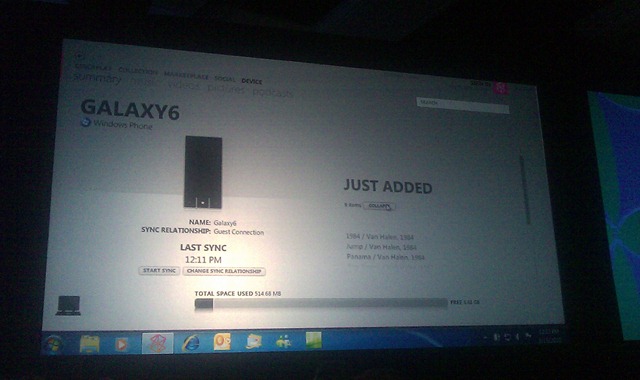
  • Windows Phone icon in the Zune software.
  • ActiveSync is GONE. Yahoo!
  • The phone will be able to sync wirelessly, just like Zune! If you are connected to your home network, you’re automatically synced. The full resolution version of all the photos will be taken off your phone every time you charge, since they found many people never take the photos off their phone.
  • Whenever you plug in to power, syncing takes place.
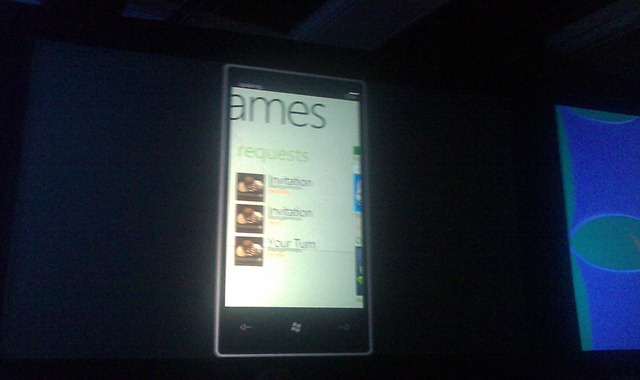
  • Game requests can be received on the phone, so you can start playing phone games with your friends. You can also be notified of when it’s "your turn," so if you’re playing chess with a friend, you’ll get a note that it’s your turn.

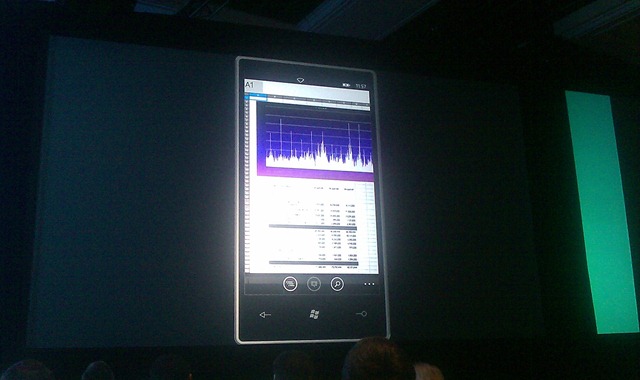
IMAG0081 
Figure: Office Excel for Windows Phone 7 Series.

IMAG0083
Figure: Windows Phone in Zune.

IMAG0084
Figure: “Your Turn” feature

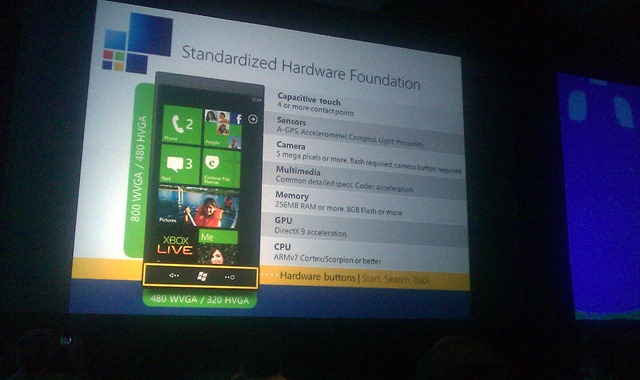
Hardware Specifications

Capacitive Touch: 4 or more contact points
Sensors: A-GPS, Accelerometer, Compass, Light, Proximity
Camera: 5 megapixels or more, Camera
Multimedia: Common detailed specs, Codec acceleration
Memory: 256 MB, 8 GB Flash or more
GPU: DirectX 9 acceleration
Processor: ARMv7 Cortex/SCorpion or better
2 screen sizes: 480×800 WVGA, 480×320 HVGA
Keyboard: Optional
Hardware Buttons: Must be fixed on the face

IMAG0085 
Figure: Hardware specifications.

Phone that you’ve been seeing in all the demos until now is an ASUS.

Also showed LG phone with keyboard and Samsung Slate with cool photo capabilities.